
Glasgow Tech Week: 5 Cyber Security Risks Glasgow Businesses Can't Afford to Ignore in 2026
Updated: Sep 18
This week marks Glasgow Tech Week. A week where businesses focus around technology, innovation, digital transformation and cyber security.
Modern and growing businesses are always adapting their approach to technology. But are they keeping pace with the security risks that come with it?
Whilst technology is increasing opportunities for Glasgow businesses through more cloud services, connected devices, remote working and AI, it is also creating more opportunities for attackers.
This highlights the need for cyber security within Glasgow businesses to become more prominent. For businesses looking at their cyber security Glasgow strategy, this isn’t just an IT issue anymore – it impacts operations, reputation, finances and customer trust – all of which are as important as each other.
Within this blog, we’re going to focus on five key cyber security risks that Glasgow businesses cannot ignore.
Risk #1 – Your employees are still one of the biggest targets
Phishing isn’t just obvious scam emails anymore.
Attackers have caught on that people are knowledgeable enough to know not to send their bank details, via email, to someone they don’t know and haven’t met.
However, that doesn’t stop them.
Attackers have moved onto using more convincing realistic language, impersonation (they are even using voice phishing or ‘vishing’ now! You can read more on that here) and social engineering. It’s important to note, that this ‘convincing’ tone they use may look real to the untrained eye. But to the trained eye, it’s very easy to spot. We’ll come onto training shortly.
Businesses may have excellent technical security but this still can be exposed through human error.
Virgin Media’s O2 Scam Index revealed that 18,000,000 adults were targeted in just three months. That’s not a typo, 18,000,000 targeted in just 3 months.
Therefore, given the big number here, human error will naturally occur.
With the rise in remote and hybrid working, 27% of working adults in the UK now operate under a hybrid working model. This increases the need for awareness of cyber security. All it takes is one compromised account and the attackers, potentially, have access to more information.
So how can Glasgow businesses increase cyber security awareness within their employee base?
Step up usecure.
Using software like usecure has great benefits for your cyber security posture and is one that many Glasgow businesses have been utilising. This software educates your staff on what to look out for. Remember that ‘convincing’ language attackers use? Not so convincing now is it.
The best way to learn is through practice. usecure runs simulated phishing email campaigns against your employees to test their awareness.
This helps you, as a business, build cyber security awareness within Glasgow businesses, specifically within your team, and improve your everyday behaviour.
Think your team would spot a phishing email? Test them here – it could save your business from trouble further down the line.
Risk #2 – Outdated technology and infrastructure - A cyber security Glasgow risk
We’ve touched on the employee aspect so let’s now focus on the technology aspect. Whilst houses generally increase in value over time, systems and software do not. This provides another potential door for attackers.
Devices that aren’t properly patched, ageing infrastructure or applications that have simply been forgotten about are all common targets.
One more thing we hear often is the “we’ll deal with it later” mentality. This is a dangerous mindset as later never arrives and before you know it, it’s too late. We always encourage businesses to take prompt action with their cyber security posture.
The technology that nobody thinks about is often the technology that nobody is protecting. These vulnerabilities don’t come from sophisticated hacking, they’re sometimes simply from weaknesses that haven’t been addressed.
For businesses reviewing their cyber security Glasgow position, we support cyber security across Glasgow businesses by providing:
· Device management
· IT audits which identify ageing and unsupported technology
· Recommendations and remediation
By outsourcing the above IT needs, you are allowing yourself to focus more on the other parts of running your growing business.
Find out more on our fully managed IT services here.

Risk #3 – Are You Getting Everything from Microsoft 365?
More than 300,000 UK companies use Microsoft 365. Whilst we have no exact figure for Glasgow businesses, it is fair to say that this software is essential.
However, how many organisations are utilising the Microsoft 365 estate to its full potential? We’d guess not as many as we hope. We view this as an opportunity to grow and develop business operations.
Microsoft 365 focuses on a layered, Zero Trust framework that emphasises identity management, threat protection and secure device configuration.
How many times have you logged onto Microsoft 365 and been asked to go through multifactor authentication (also known as MFA, two-factor authentication or 2FA) and subsequently went “I can’t be bothered with this!”
Well, this step is actually very, very important and helps keep crucial information safe. This is particularly important if you work in an industry or business where confidential information is shared on a regular basis.
All of the aforementioned features should be reviewed regularly by your team, especially if your business is growing in headcount.
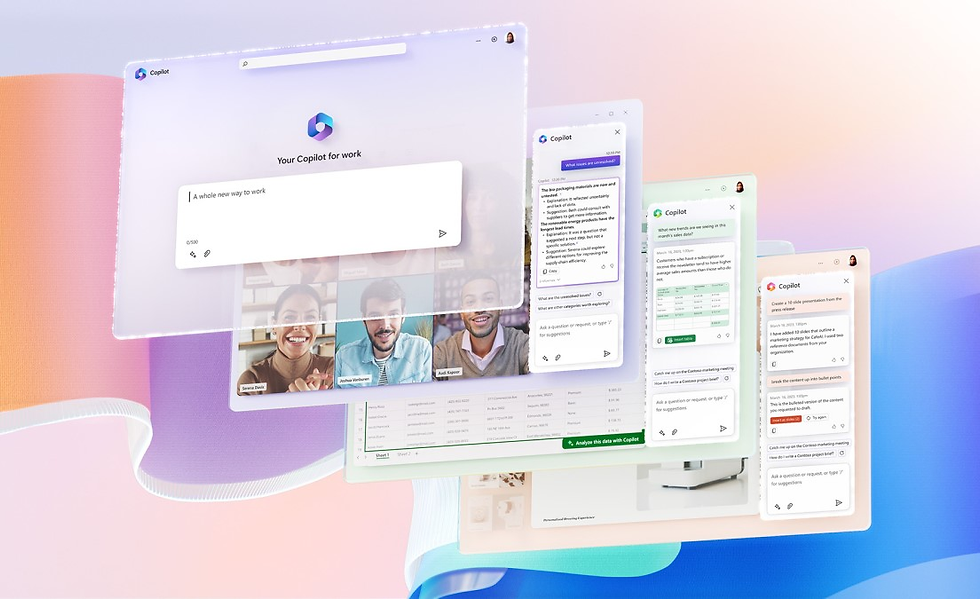
64% of Scottish businesses use AI on a regular basis. This will include Microsoft Copilot, which is an extremely useful tool that we’d recommend for businesses to utilise on a daily basis.
Copilot can perform tasks such as:
· Summarising emails and meetings
· Analysing data in Excel
· Create presentations
· Reduce repetitive tasks
· And much, much more!
Whilst we recommend incorporating Copilot into your organisation, it is important to do so with caution, if you’ve never used this feature before.
We use Copilot internally and provide support to businesses across the UK with fully managed rollouts and real-world advice.
Our team are fully trained on Copilot and already provide ongoing support with best practice. This means we are uniquely positioned to understand the challenges that businesses face with the software.
We also provide discounted Copilot licences to new and existing customers and free solution assessments for your Microsoft 365 environment. You can contact us here to find out the best solution for your business.
We’re pleased to see many AI relevant events during Glasgow Tech Week and our team will be in attendance at various of these events. AI is here now and it’s our turn to embrace it and learn how best to utilise this software.
Don’t risk getting left behind. Make sure your business is in the best position to grow and develop.
Risk #4 – Your business isn’t prepared for a cyber incident
Good cyber security focuses on preventing cyber-attacks. Great cyber security focuses on that and also how to respond to one.
Cyber-attacks can vary from limited to business-critical. Consequences include; loss of access to systems and files, employees being unable to work, disruption to customer services, financial impact, damage to reputation and potential loss of important business data.
This highlights the need for a strong backup system. One common question we get from clients is ‘how often should we back up our business data?’. All businesses should put in regular tests to avoid a cyber security incident. Naturally, the answer here depends on a variety of factors relevant to your specific business.
The one thing all businesses should focus on here is their Recovery Point Objectives (RPO).
This essentially means how much data could your business deal with losing.
In the simplest possible terms:
If your RPO is one day, then your business is saying we can deal with losing one day’s worth of data and still function.
If your RPO is one hour, then it is the same but for one hour instead of one day.
If your RPO is zero, you cannot afford to lose any data at all – this is the type of business that must backup its data most regularly.
Next up, it is important to have an incident response plan. If a cyber security incident does occur, who is responsible for managing your team to get your systems back up and running?
Who’s in charge of the response?
Who’s in charge of communication?
Who deals with customers and / or other stakeholders?
These are just a few of the important questions you should be establishing as soon as possible.
The famous quote goes: “Failing to prepare is preparing to fail”. But it’s true, particularly in this instance!
KubeNet has helped a number of Glasgow businesses strengthen their cyber security by building resilience alongside prevention through our managed IT services. This means not only putting the right measures in place to reduce the risk of an attack, but also ensuring businesses have the monitoring, support, backup and recovery processes they need to respond effectively if something does go wrong.
By taking a proactive approach to both prevention and resilience, we help Glasgow businesses strengthen their cyber security, minimise disruption and get back to normal as quickly as possible.
Strong cyber security means being prepared, not panicked.
Risk #5 – You Don’t Know What You Don’t Know
An apt final risk to touch on during Glasgow Tech Week.
A growing business has many different areas to focus on. But one that is very often overlooked is a business not knowing where its weaknesses are, and there’s nothing wrong in this.
As a growing business ourselves, we’re aware of the various challenges you will be facing. We know better than most how quickly the technology world changes.
Every new hire will likely need some form of work device and will almost definitely need an account of some sort. That’s before you factor in cloud services, access permissions, connected systems, remote working and new technology being introduced.
It can be difficult to maintain a complete picture of your security position.
This is where having the right support makes a real difference. We don’t believe cyber security should be about waiting for something to go wrong before acting. Our approach is focused on giving businesses ongoing visibility of their technology and security environment, so potential issues can be identified and addressed before they become bigger problems.
This starts with understanding what you already have. Through IT audits and cyber security assessments, we can help identify potential weaknesses across your devices, infrastructure, systems and users, giving you a clearer picture of where improvements may be needed.
From there, ongoing monitoring and device and infrastructure management help us keep track of your environment as it changes. New devices, software, users and systems can all introduce potential vulnerabilities, so having someone keeping an eye on these changes means issues are less likely to go unnoticed.
It’s not just the technology that needs attention either. Employees remain an important part of your overall security awareness and improving security awareness can give businesses greater visibility of potential risks within their teams.
We also use Huntress to provide threat detection and response, helping identify and respond to potential threats as they emerge.

Most importantly, this isn’t something you should have to figure out on your own. Our team provides ongoing technical guidance, helping businesses understand what their security position looks like, where improvements may be needed and how their approach should change as the business, technology and threat landscape develops.
Because you don’t know what you don’t know. Having ongoing visibility means you can find those weaknesses, understand the risks and take action before they become a much bigger problem.
Glasgow Tech Week brings with it a great opportunity to focus on cyber security in Glasgow, how technology is changing for modern businesses and what this means for them / how to keep up with this.
Often, we see excellent businesses growing year on year, yet their cyber security posture stands still. At that point, it’s a matter of time before the business gets caught out. Having a strong and robust cyber security posture should now be an essential part of any business operation.
It’s easy to focus on the opportunities technology creates, but businesses also need to consider the risks that come with those opportunities.
The risks covered within this article should demonstrate that cyber security isn’t just about one thing. Instead, it’s about: your people, your technology, your Microsoft 365 environment (how it is configured and how it is used), being prepared if something goes wrong and also knowing where your weaknesses are.
With so many things to focus on, it is completely understandable when business owners struggle to keep up with them. That’s why Glasgow businesses outsource their IT and cyber security to KubeNet.
We’re able to understand their current IT and security position, identify vulnerabilities and areas for improvement, monitor their environment, manage devices and infrastructure, improve employee security awareness, detect and respond to threats and provide ongoing technical guidance.
The best part? We’re able to do all of this whilst you focus on running your business.
A few things to take away from this article today:
When was the last time your IT environment was properly reviewed?
Does your IT provider send regular cyber security updates?
Are you making the most of the security features available to you?
If you don’t know the answers to all these questions, that’s okay. That’s exactly where ongoing support can help.
You can chat to us today to discuss your IT and cyber security requirements.
Comments